





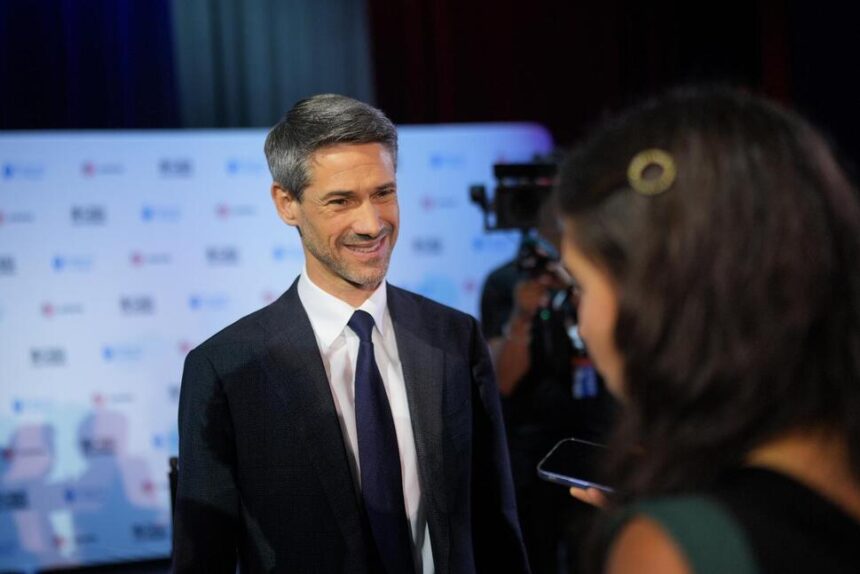
Tech Billionaires Are Betting Big on Matt Mahan in California’s Governor Race
Tech billionaires are betting big on Matt Mahan as the California governor race begins to take shape ahead of the June primary. The San Jose mayor has quickly become Silicon Valley’s favorite Democrat, attracting millions of dollars from wealthy investors, startup founders, and artificial intelligence executives who see him as a business friendly alternative to traditional party leaders. His campaign is now testing whether California voters still trust the tech industry to shape the state’s political future.
Mahan entered the crowded governor’s race in January and immediately positioned himself as a moderate Democrat focused on practical solutions instead of ideological fights. At 43, the former tech executive has tried to present himself as a problem solver who can bridge the growing divide between progressive activists and corporate leaders in California.
His message has resonated strongly with Silicon Valley donors. Several major tech figures have already poured money into independent groups supporting his campaign. Some even funded a Super Bowl advertisement designed to introduce him to voters across the state.
The financial support has helped Mahan outpace many better known Democrats in fundraising. Within just a few months, he raised more money than several rivals who had spent more than a year building statewide campaigns. Billionaire activist Tom Steyer remains one of the few candidates capable of matching that financial power because he is largely self funding.
During a recent CNN debate, Mahan leaned heavily into his outsider image. He criticized career politicians and argued that California’s leadership has failed to address homelessness, crime, housing affordability, and economic anxiety.
“We don’t need MAGA values, but we also don’t need more of the same,” Mahan said during the debate.
That line captured the core strategy of his campaign. Mahan wants voters to see him as a centrist Democrat who can reject both Republican culture war politics and what he describes as ineffective Democratic governance.
Still, his rapid rise has also triggered serious backlash from labor groups and progressive Democrats. Critics argue that Mahan’s deep connections to Silicon Valley raise concerns about whose interests he would prioritize if elected governor.
Lorena Gonzalez Fletcher, president of the California Labor Federation, accused Mahan of being too close to powerful tech elites. Labor organizations have instead backed candidates like Tom Steyer, former Representative Katie Porter, and former Los Angeles Mayor Antonio Villaraigosa.
“People do not want somebody who is a puppet of these big tech billionaires,” Gonzalez Fletcher said.
The criticism reflects a broader political shift happening across California. Public trust in major technology companies has weakened in recent years as concerns over artificial intelligence, social media influence, privacy, and corporate power continue to grow.
Mahan has pushed back aggressively against the idea that he would be soft on regulating tech companies. He argues that his experience inside the industry gives him a better understanding of how government should respond to rapid technological change.
As mayor of San Jose, Mahan created a coalition involving hundreds of public agencies working together to explore responsible uses of artificial intelligence in government operations. He has also said he supports taxing AI companies to help fund workforce training programs for displaced workers.
“Voters can see past the shallow connection that because I’m the mayor of Silicon Valley, that might mean I’m not willing to regulate tech,” Mahan told reporters. “It’s actually been quite the opposite.”
Even so, watchdog groups remain skeptical. Progressive consumer advocates argue that Silicon Valley’s massive financial investment in Mahan’s campaign is not accidental. They believe tech executives see California’s next governor as critical to future regulation battles involving AI, labor protections, and corporate accountability.
Independent political groups supporting Mahan have reportedly raised more than $25 million so far. Major contributors include Google co founder Sergey Brin, venture capitalist Michael Moritz, and Reddit CEO Steve Huffman.
Some tech donors appear to be spreading their bets across multiple candidates. Billionaire investor Joe Lonsdale and Brin have also donated to Republican candidate Steve Hilton, the former Fox News host endorsed by Donald Trump.
Mahan’s personal background also plays a major role in his campaign narrative. Although he built his career in technology, he often highlights his middle class upbringing as the son of a postal worker and a schoolteacher.
After graduating from Harvard, Mahan worked alongside future Meta CEO Mark Zuckerberg. He later helped build an early Facebook application called Causes, which allowed users to support nonprofit organizations online. He eventually co founded Brigade, a nonpartisan civic engagement platform focused on voter participation.
Despite his Silicon Valley resume, Mahan has tried to distance himself from elite political branding. He is the only major Democrat in the race openly calling for a suspension of California’s gas tax, a position aimed at voters struggling with high living costs.
His record as San Jose mayor has centered heavily on homelessness and public safety. Mahan pushed city leaders to invest more money into temporary housing and shelter programs while also supporting policies that allowed homeless individuals to face arrest if they repeatedly refused shelter offers.
Those policies sparked fierce criticism from activists, but supporters argue they produced measurable results. County data later showed a decline in the number of unhoused people without shelter access in San Jose.
Mahan also broke with Governor Gavin Newsom by supporting a tougher crime ballot measure in 2024. That move helped strengthen his image as a moderate willing to challenge Democratic orthodoxy on policing and public safety.
Still, his campaign faces serious challenges as the primary election approaches. Polling suggests many voters still know little about him despite the enormous financial backing behind his candidacy.
His fundraising numbers also reveal another potential weakness. Only a small fraction of donations to his campaign came from small grassroots contributors. Rivals like Katie Porter and Xavier Becerra have attracted far larger numbers of low dollar donors, a sign of broader voter enthusiasm.
That gap matters in California politics, where grassroots energy often determines momentum in crowded Democratic races.
Mahan remains confident that voters are still persuadable. He argues that many Californians feel frustrated with the state’s direction and are searching for leaders outside the traditional political establishment.
During a recent Reddit question and answer session, some users even asked whether he planned to drop out to avoid splitting Democratic support and potentially allowing two Republicans to advance to the general election.
Mahan gave a short response that captured both the ambition and risk surrounding his campaign.
“I plan to win!”