





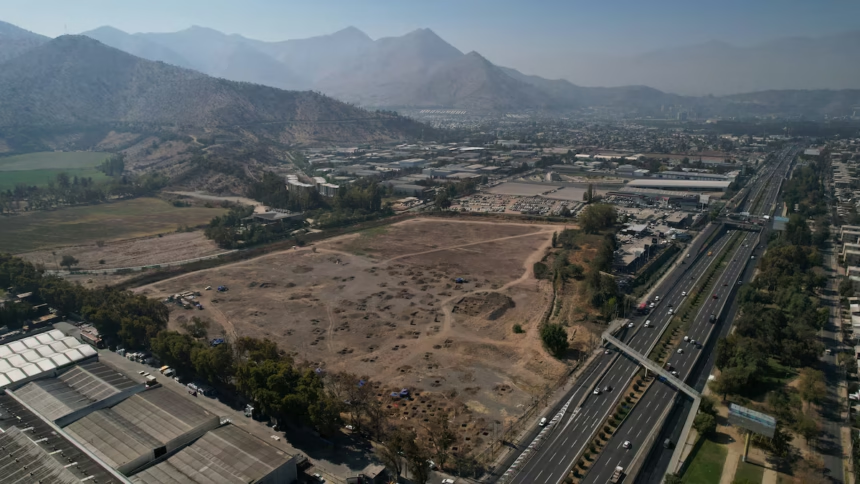
Amazon’s Massive Chile Data Center Project Sparks Environmental Fears Near Santiago
Residents living on the northern edge of Santiago are pushing back against a major new data center project from Amazon Web Services, warning that the development could permanently reshape their community and damage local green spaces near the Andes mountains.
Among the most vocal critics is Patricio Hernandez, who says the hillside area plays an important role for local families seeking relief from the crowded urban environment of Santiago.
“This hill is very important to the community,” Hernandez said while walking along dirt trails near a stream flowing below the mountains.
“It is a green space, a place for recreation and for community.”
The project is part of Amazon’s growing global investment in cloud computing infrastructure and artificial intelligence technology. Demand for data centers has exploded worldwide as companies race to expand digital storage, AI computing power, and internet services.
But the rapid expansion has also triggered rising environmental concerns in many countries. Critics argue that large scale data centers consume enormous amounts of electricity and water while increasing pressure on local infrastructure and ecosystems.
In Chile, residents attempted to block the Amazon project through legal action. Community groups argued that environmental permits failed to properly consider the future construction of a high voltage transmission line that they believe will eventually be required to power the facility.
Their challenge was unsuccessful.
Environmental authorities in Chile ruled in early April that the data center project could move forward. Regulators said any future proposal involving power line infrastructure would need to be reviewed separately under environmental law.
Amazon Web Services defended the project and said its Santiago operations are being designed with sustainability in mind. Company officials say the data center will use technologies aimed at minimizing energy and water consumption.
“Our approach has been to design this infrastructure with a strong emphasis on resource efficiency,” said Rafael Mattje.
The company’s investment plans in Chile are massive. AWS has announced it will spend more than $4 billion over the next 15 years building and operating cloud infrastructure across the country. Santiago is expected to become Amazon’s third major data center hub in Latin America after São Paulo in Brazil and central Mexico.
The expansion reflects the growing importance of Latin America in the global technology economy. Countries with strong internet connectivity, political stability, and supportive business policies are increasingly attracting investment from major technology companies competing in the artificial intelligence boom.
Chile’s new president, Jose Antonio Kast, has publicly supported reducing regulations and speeding up investment approvals. Analysts say that approach could make Santiago an increasingly attractive destination for international data center developers.
“Chile is a magnet for this industry,” said Sebastian Diaz, a former adviser involved with Chile’s national data center strategy.
At the same time, Diaz warned that governments must carefully balance economic growth with environmental protection and quality of life for local communities.
That debate is becoming increasingly common worldwide as artificial intelligence accelerates demand for computing infrastructure. Large data centers require massive cooling systems and constant electricity supplies, raising concerns about carbon emissions, water shortages, and stress on electrical grids.
Environmental groups in several countries have already challenged new data center developments tied to AI expansion. Similar concerns have emerged in parts of the United States, Europe, and Asia where residents fear industrial scale technology projects could overwhelm local resources.
AWS says its Santiago complex is expected to operate for roughly 30 years once completed. The facility will join dozens of Amazon data centers already operating across the Americas and more than 900 facilities worldwide.
For many local residents, however, the issue is about more than technology investment or economic growth. They worry the construction could fundamentally alter the character of the neighborhood and erase one of the few remaining natural spaces near the city.
“We wake up every day to a green hill that brings us a little joy amid the gray of the city,” Hernandez said.
That emotional connection to the landscape has become central to the resistance movement. While Chile continues positioning itself as a regional technology hub, communities like this one are increasingly asking whether the environmental cost of the AI economy is becoming too high.